Uncategorized

Bitcoin’s Drop Below $70,000: A Critical Warning Sign for the Crypto Market

Bitcoin's Drop Below $70,000

The cryptocurrency market is currently navigating a highly volatile and precarious environment, as the flagship digital asset, Bitcoin (BTC), faces significant downward pressure. Recently, Bitcoin losing the crucial $70,000 threshold has emerged as a stark warning sign for further potential downside. While traders and investors were initially optimistic about recent market movements, a confluence of technical breakdowns, shifting institutional flows, and overarching macroeconomic anxieties have dramatically altered the short-term outlook. As the crypto majors continue to soften and traders meticulously weigh the impact of everything from quantum computing fears to exchange-traded fund (ETF) flows, the broader trend for Bitcoin appears to be undergoing a fundamental shift. This comprehensive SEO-optimized analysis delves into the intricate details of Bitcoin’s recent price action, the underlying on-chain metrics, and the macroeconomic headwinds that are currently dictating market sentiment, providing you with the insights needed to navigate this uncertain terrain.

The Technical Landscape: Unpacking Bitcoin’s Critical Price Reversal

From a strictly technical analysis perspective, Bitcoin is demonstrating significant signs of weakness after definitively failing to sustain its gains above the pivotal $70,000 mark. Earlier in the week, the largest cryptocurrency by market capitalization made a brief, concerted attempt to reclaim this critical level on Monday. However, this upward momentum was swiftly rejected as aggressive sellers emerged around the breakout zone, pushing the price down toward the $67,000 level. By early Wednesday, Bitcoin was trading near $68,000, which was roughly flat for the day but ominously sitting just underneath what had previously served as a reliable short-term support level. By Wednesday afternoon, the situation deteriorated further as Bitcoin fell back to $66,000, directly testing the lower boundaries of its recent trading range.

This shift in price dynamics is incredibly important for market participants to understand. Throughout the first half of February, the trading range between $68,000 and $70,000 had acted as a robust floor, providing a solid foundation for bullish sentiment. Losing this foundational floor substantially increases the risk that market rallies are now being viewed by traders as opportunities to sell, rather than opportunities to buy. The technical battle remains the absolute front-and-center issue for Bitcoin right now: if the asset can successfully reclaim $70,000, the bullish momentum could seamlessly reset. Conversely, a clean and sustained break under the $67,000 mark would immediately put lower support levels—specifically $65,000 and possibly even $60,000—squarely back into focus for traders. If the asset fails to hold its ground again, the market will likely begin pricing in a much deeper retracement. Alarmingly, Bitcoin is currently on track to record its fifth consecutive weekly decline, and firmly losing these current support levels could easily open the floor for a fresh leg lower in the broader market.

A Tale of Two Markets: Major Cryptos vs. Altcoin Resilience

While the mainstream focus remains largely on Bitcoin’s price prediction, the broader cryptocurrency market is currently exhibiting a fascinating divergence between large-cap majors and smaller-cap altcoins. Major cryptocurrencies, including Bitcoin (BTC), Ethereum (ETH), and Binance Coin (BNB), have all experienced notable declines of as much as 3% over a seven-day period. In stark contrast, smaller tokens have recently displayed remarkable, perhaps unexpected, resilience. Assets such as Zcash (ZEC) and Cosmos (ATOM) have actively defied the broader market gravity, posting impressive gains of as much as 20% over the exact same past week.

However, industry experts strongly warn that this divergence may be extremely short-lived. Historically speaking, when the major market leaders lag in performance, the rest of the cryptocurrency ecosystem traditionally struggles to sustain any meaningful upside momentum. According to Alex Kuptsikevich, the chief market analyst at FxPro, this current market dynamic is deeply concerning. Kuptsikevich stated in an email that the decline of the largest coins serves as an “ominous sign” for smaller tokens, warning that the weakness in large caps could soon filter through and pull the smaller assets down at an accelerated pace. Therefore, while altcoin holders might currently feel insulated from Bitcoin’s recent drop, the historical precedent suggests that widespread market contagion remains a highly probable risk.

(Note: To provide additional context outside of the provided sources, it is a common phenomenon in cryptocurrency markets for profits from Bitcoin rallies to temporarily rotate into smaller altcoins, an event colloquially known as “alt-season.” However, when Bitcoin breaks critical macro support, liquidity is often rapidly drained from these smaller, riskier assets as investors flee to safety. I strongly encourage readers to independently verify broader market cycle theories.)

On-Chain Data Signals a Prolonged “Stress Phase”

Beyond the surface-level price charts, on-chain data provides a much deeper, more granular look into the psychological state of the crypto market. Analysts at CryptoQuant have closely examined the underlying blockchain metrics and concluded that the cryptocurrency market has officially entered a highly volatile “stress phase”. This classification suggests that network participants are currently experiencing elevated levels of anxiety and holding unrealized losses.

Crucially, these on-chain analysts note that despite the recent downward pressure, the market has not yet witnessed the type of heavy loss realization that typically characterizes a definitive cycle bottom. In cryptocurrency market cycles, a true bottom is often marked by a “capitulation” event—a moment of extreme panic where investors en masse sell their holdings at a significant loss, completely clearing out the weak hands. Because CryptoQuant’s data indicates that this definitive capitulation bottom is currently absent, it suggests to analysts that the current market unwind may not yet be completely finished. This lack of a clear capitulation bottom strongly implies that further downside volatility could still be on the horizon before a true, sustainable recovery can effectively begin.

Macroeconomic Headwinds: The Federal Reserve and Equities

Cryptocurrency does not exist in a vacuum, and recent macroeconomic developments are currently playing a massive role in suppressing Bitcoin’s overall price. A primary catalyst for the recent market weakness is the surprisingly hawkish tone revealed in recent Federal Reserve minutes. The minutes mentioned a possible interest rate hike, which immediately sent shockwaves through traditional and digital financial markets alike.

This hawkish macroeconomic stance had an immediate and direct impact on global currency markets, causing the U.S. dollar to notably strengthen. A stronger U.S. dollar traditionally puts immense downward pressure on risk assets, including both traditional equities and cryptocurrencies, as it makes dollar-denominated assets relatively more expensive and less attractive to hold. Consequently, as the Federal Reserve minutes were digested by investors, U.S. stocks began to aggressively lose their momentum. This bearish sentiment quickly bled into crypto-related equities, which sharply reversed their early daily gains. For instance, the prominent crypto exchange Coinbase experienced a dramatic intraday swing, moving from a 3% rise in the morning to a 2% loss, while Strategy similarly slipped by approximately 3%.

Interestingly, this U.S.-centric macroeconomic turbulence contrasted sharply with movements in the Asian markets. Outside the crypto sphere, Asian equities actually advanced during a period of thin Lunar New Year trading, with the MSCI Asia Pacific Index rising by 0.6%, largely led by robust gains in the Japanese market. Meanwhile, U.S. futures had only edged higher earlier in the period—after recent turbulence related to artificial intelligence cooled down—before the hawkish Fed minutes ultimately took their toll.

Shifting Institutional Tides: Examining Bitcoin ETF Outflows

Adding another thick layer of complexity to Bitcoin’s current market structure is the clear shifting of institutional fund flows. Following the highly anticipated launch of spot Bitcoin Exchange-Traded Funds (ETFs), market analysts have been keeping an incredibly close eye on how large, traditional institutional players are managing their crypto exposure.

Recent institutional data reveals that some major entities are opting to aggressively reduce their risk. Notably, Harvard University’s massive endowment made a significant move by cutting more than 20% of its Bitcoin ETF exposure during the fourth quarter. While this sizable reduction is a clear sign of institutional profit-taking or risk mitigation in the face of ongoing market uncertainty, it is also important for crypto investors to maintain perspective. Despite this substantial 20% cut, the Bitcoin ETF still remarkably remains the endowment fund’s absolute largest public cryptocurrency position. This specific data point indicates that while legacy institutions may be tactically adjusting their portfolios and taking some chips off the table, they have not entirely abandoned their long-term foundational thesis on the digital asset.

Technological Debates: Quantum Fears and Network Spam

As crypto traders rapidly weigh overarching macroeconomic and technical factors, the underlying Bitcoin network is also facing its own internal debates and perceived existential tech threats. Adding to the general unease in the broader market, the highly complex topic of quantum computing has recently resurfaced in active market conversations. Some cautious institutional investors are beginning to actively question the long-term cryptographic risks associated with quantum computers, fearing that future technological advancements could potentially break Bitcoin’s underlying security model. However, it is deeply worth noting that prominent blockchain software developers are actively pushing back against these fears, successfully arguing that the realistic timelines for any meaningful quantum threats are still placed decades away.

Simultaneously, a fierce ideological debate is currently raging within the elite Bitcoin development community regarding a highly controversial proposal known as BIP-110. This proposed technical update is specifically aimed at heavily reducing the amount of spam on the core Bitcoin network. However, Adam Back, the CEO of Blockstream and a legendary figure in the cryptocurrency space, has publicly and vehemently criticized the BIP-110 proposal. As noted by CoinDesk reporters, Back fundamentally argues that the update could inadvertently create entirely new reputational risks for the entire network by radically changing the established, decentralized rules regarding exactly what types of transactions should be allowed to be processed. These internal governance debates add an extra, unexpected layer of friction and uncertainty for everyday investors trying to gauge the long-term stability of the protocol.

Conclusion: Navigating the Warning Signs

In conclusion, Bitcoin losing the $70,000 level is not merely a minor technical blip; it is a profound warning sign that indicates the severe potential for further, significant downside. The largest cryptocurrency is currently trapped in a complex, interlocking web of bearish technical indicators, shifting institutional sentiment, and overwhelmingly hawkish macroeconomic forces. With the critical foundational support floor of $68,000 to $70,000 now fundamentally broken, and the asset aggressively testing the $66,000 range, the immediate risk is skewed heavily to the downside, with $65,000 and $60,000 looming ominously as the next major battlegrounds.

Furthermore, with on-chain data explicitly confirming a “stress phase” devoid of a true capitulation bottom, and hawkish Federal Reserve minutes strengthening the U.S. dollar to the absolute detriment of risk assets, crypto traders must exercise extreme caution. While smaller altcoins have shown temporary resilience, deep market history warns that a sustained drop in major market caps will almost certainly drag the broader crypto ecosystem down with it. As the community simultaneously wrestles with internal structural debates over network spam and long-term quantum computing risks, the path forward for Bitcoin remains fraught with unprecedented challenges. Investors should closely monitor the ongoing technical battle around the $67,000 to $70,000 marks, as the ultimate outcome of this struggle will likely dictate the broader macroeconomic trend for the weeks and potentially months to come

Why the Fed Sees Crypto Volatility as a Market Feature, Not a Banking Crisis

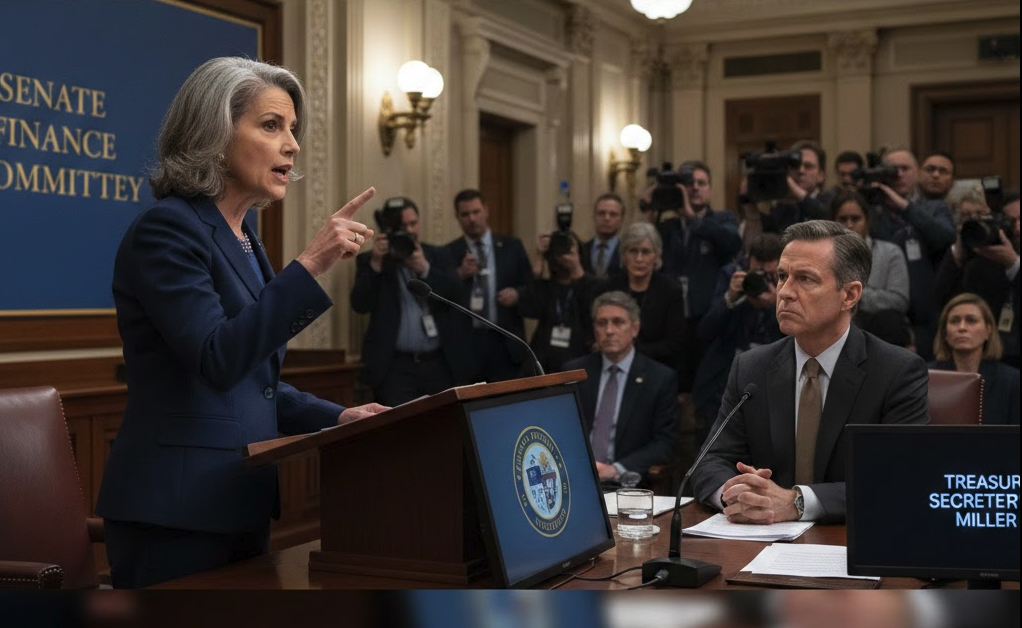
Federal Reserve Governor Christopher J. Waller has delivered a definitive message to the financial world regarding the tumultuous nature of cryptocurrency markets: the volatility is real, but the systemic threat to the banking sector is not. Speaking at a recent event hosted by the Global Interdependence Center, Waller offered a calm, pragmatic assessment of the digital asset landscape, downplaying fears that crypto crashes could trigger a domino effect within the traditional financial system.

At a time when digital assets are increasingly intersecting with mainstream portfolios, Waller’s comments provide a significant glimpse into how the central bank views the boundary between decentralized finance and the established economy. Rather than viewing crypto as an existential risk or a dangerous anomaly, Waller framed the market as an extension of everyday commerce—a separate ecosystem where high-stakes volatility is simply “part of the game” rather than a contagion waiting to infect Wall Street.

The “Detachment” Thesis

The core of Waller’s argument rests on the degree of separation between the crypto ecosystem and the traditional banking world. Despite the headlines generated by massive price swings, Waller emphasized that these fluctuations remain largely contained. He pushed back against the narrative that a crash in Bitcoin or other tokens poses an immediate danger to the stability of banks or the broader payments system.

“These things are pretty detached from the traditional finance world,” Waller explained. “You can have these big crashes and move volume. The rest of us wake up and we’re fine the next day. Nothing bad’s going on. The banks are open. Your payments are being made”.

This “detachment” thesis suggests that while crypto investors may suffer significant losses during downturns, the structural integrity of the economy remains untouched. Waller noted that he does not even closely monitor crypto markets as part of his day-to-day responsibilities at the Fed, further underscoring his view that the sector currently sits outside the “core” of the financial system.

Volatility as a Feature, Not a Bug

Waller addressed the notorious price swings of digital assets with a long-term perspective that dismisses immediate panic. He pointed out that the crypto market has established a cyclical character, where booms and busts are so routine they have earned their own terminology.

“Ups and downs in the crypto world have become so common they actually have a name for them: winters,” Waller said. “It’s part of the game”.

To illustrate his point, Waller contextualized recent price drops. While a decline to $63,000 for Bitcoin might trigger alarm bells for new investors, Waller reminded the audience of how far the asset has come. He noted that only eight years ago, a price of $10,000 would have been considered “crazy” high. By viewing these fluctuations through a longer lens, Waller suggested that what is often perceived as a crisis is merely a correction within a highly speculative market.

His advice to investors navigating this volatility was blunt and unequivocal: “Prices go up. Prices go down. If you don’t like it, don’t get in”.

Distinguishing the Tool from the Trade

A critical distinction in Waller’s analysis is the separation of the asset (the crypto token) from the technology (the blockchain). He compared a typical blockchain transaction to the mundane act of buying an apple at a grocery store. While the “rails” (the technology) and the “objects” (the assets) differ from traditional commerce, the basic structure of payment, execution, and recordkeeping remains the same.

“In the decentralized crypto world, a crypto asset, or digital asset, is the object that people want to buy,” Waller clarified. He described the underlying mechanisms—blockchains, tokenization, and smart contracts—as neutral tools rather than inherent threats.

“Those are just technologies,” Waller asserted. “There’s nothing dangerous about them. There’s nothing to be afraid of”.

This perspective effectively demystifies the technology, positioning it not as a shadowy force but as a new set of digital instruments that can be used for various purposes, including legitimate financial innovation.

The 24/7 Revolution and Legacy Systems

While dismissing the systemic risks of crypto assets, Waller acknowledged the potent influence of blockchain technology on financial infrastructure. He highlighted that traditional firms and even the U.S. Treasury are exploring tokenized securities, driven by the efficiency of blockchain systems.

The primary advantage of these new technologies, according to Waller, is their ability to operate globally around the clock. He contrasted this with “legacy systems” that are often bound by standard business hours and slower clearing cycles.

“These technologies were built to do this globally, 24 by seven from the beginning,” Waller noted. “They’re not legacy systems”.

This technological pressure is forcing traditional financial institutions to adapt. Waller argued that the existence of crypto rails is compelling big banks to upgrade their own payment systems to remain competitive, particularly regarding cross-border transfers. The competition from crypto is, in effect, driving the established players to make payments “faster and cheaper”.

The Regulatory Standoff

Despite the technological promise, Waller emphasized that the sector remains hampered by regulatory uncertainty. He pointed to the lack of clear definitions regarding whether specific tokens should be treated as securities or commodities—a determination that falls to Congress, the SEC, and the CFTC.

Waller expressed skepticism about the pace of legislative progress. “The bigger problem is clarity,” he said, noting that efforts in Congress appear to have stalled. “Everybody thought clarity would come in that would clear the road… It doesn’t look like it’s going anywhere anytime soon”.

He suggested that this legislative gridlock has cooled enthusiasm in the market, as expectations for a quick regulatory framework—a “clarity act”—have faded. Without these clear rules of the road, the integration of digital assets into the broader economy remains tentative, leaving the market in its current state of speculative volatility and detached “winters.”

Conclusion

Governor Waller’s comments paint a picture of a Federal Reserve that is watchful but not alarmed. By categorizing crypto volatility as a contained phenomenon and distinguishing the speculative assets from the useful underlying technology, Waller argues that the banking system is insulated from the “crypto winters.” While the technology forces necessary modernization upon legacy banks, the “big crashes” of the crypto world remain, for now, a game for those willing to play it—leaving the rest of the financial world to wake up the next day, business as usual

The Institutional Pivot: Goldman Sachs and the Billion-Dollar Bitcoin Bet

Introduction: A Major Disclosure Wall Street giant Goldman Sachs has officially cemented its status as a major player in the cryptocurrency space. According to recent financial holding disclosures, the investment bank has revealed a massive expansion of its digital asset holdings, reporting approximately $2.36 billion in total crypto exposure. The most significant portion of this portfolio is dedicated to Bitcoin, marking a decisive shift for a firm that had historically maintained a skeptical stance toward the asset class.

Breaking Down the Holdings The centerpiece of Goldman Sachs’ crypto strategy is its substantial investment in Bitcoin Exchange-Traded Funds (ETFs). The disclosures reveal a $1.1 billion position specifically in BlackRock’s iShares Bitcoin Trust ETF (IBIT). This single position represents the largest share of any digital asset listed in their holdings.

Beyond the headline-grabbing BlackRock investment, the bank’s Bitcoin exposure is diversified across several other vehicles and entities:

Fidelity’s Wise Origin Bitcoin Fund: The filings show holdings of approximately $35.8 million.

Market Infrastructure and Mining: Goldman Sachs holds roughly $92,000 in American Bitcoin and approximately $57,000 in Bitcoin Depot, alongside investments in various other Bitcoin mining or cloud-based companies.

Derivatives: The bank is not just holding spot ETFs; it is actively managing risk and exposure through derivatives, with filings indicating the firm holds hundreds of thousands in IBIT calls and puts.

Furthermore, Goldman’s crypto appetite extends beyond Bitcoin. Filings from the same period indicate that the bank also holds positions in other major cryptocurrencies, including Ethereum, XRP, and Solana.

The Evolution of a Strategy This multi-billion dollar disclosure highlights how far Goldman Sachs has moved from its earlier public posture. For much of its history, the bank was “publicly circumspect” regarding cryptocurrencies, with executives often distancing the institution from Bitcoin as a viable investable asset class.

However, the path to the current portfolio began over five years ago with tentative steps.

2022 Milestones: The firm executed its first known Bitcoin-backed loan and a non-deliverable Bitcoin options trade. These moves were viewed as early strategic steps into the digital asset ecosystem.

2024 Acceleration: The posture shifted notably in 2024. SEC filings from this period revealed the bank’s first meaningful accumulation of Bitcoin ETFs. Within months, Goldman appeared to triple its Bitcoin ETF stake, bringing those specific holdings to roughly $1.5 billion and positioning itself as one of the largest institutional holders of Bitcoin ETFs.

Market Context: Volatility and Resistance Goldman Sachs’ deepening involvement comes during a period of complex price action for Bitcoin. The asset has recently struggled to maintain its footing above the psychologically significant $70,000 level.

Recent market behavior has been characterized by sharp volatility:

The Selloff: Bitcoin experienced a sharp decline recently, breaking down through both the $70,000 and $60,000 ranges before finding support near $60,000.

The Rebound: After capitulating at the $60,000 level, bulls managed a strong recovery, pushing the price back up to approximately $71,700 before closing the week near $70,315.

Despite this recovery, the sources indicate that overall sentiment remains bearish, with bears controlling much of the downside momentum.

Technical Outlook: Key Levels to Watch For investors watching Goldman’s massive bet play out, several technical indicators define the current market landscape.

Resistance Levels: The immediate area to watch is 71,800∗∗,wherethepricewasrecentlyrejected.Abovethatliesthe0.382Fibonacciretracementlevelnear∗∗74,500. Stronger resistance is anticipated at 79,000∗∗and∗∗84,000.

Support Levels: To sustain a reversal attempt, bulls must hold the price above 65,650∗∗and∗∗63,000. The 60,000∗∗levelisidentifiedascriticalsupport.Justbelowthissitsthe0.618retracementat∗∗57,800, which may represent the “true floor” for the asset.

Conclusion Goldman Sachs’ disclosure of $2.36 billion in crypto exposure—anchored by over $1 billion in BlackRock’s Bitcoin ETF—represents a significant milestone in the institutional adoption of cryptocurrency. While the market grapples with bearish sentiment and critical technical resistance levels, the “venerable investment bank” has clearly signaled that digital assets are now a meaningful component of its portfolio strategy

The Identity Crisis: Why Bitcoin Trades Like Tech, Not Gold

Introduction: The Tech Trade Reality

For years, proponents of cryptocurrency have championed the narrative of “digital gold”—the idea that Bitcoin serves as a non-sovereign, scarce store of value that can hedge against traditional market volatility. However, recent market data suggests that this narrative is, for the moment, premature. According to a recent report by crypto asset manager Grayscale, Bitcoin is currently behaving less like a mature safe haven and more like a speculative technology play.

During the sell-off earlier this month, which saw Bitcoin slide to approximately $60,000, the asset did not behave in the way gold investors would recognize. Instead, the decline looked familiar to tech investors. As high-growth software stocks retreated, Bitcoin fell in “near lockstep,” reinforcing the perspective that the world’s largest cryptocurrency currently trades as an emerging technology rather than a stabilized store of value.

The Maturity Gap: 17 Years vs. Millennia

The core of the issue lies in the timeline of adoption and trust. Grayscale’s analysis highlights a fundamental distinction between the potential of Bitcoin and its current state. Bitcoin possesses the necessary design features to function as a long-term store of value: it has a capped supply, it operates independently of governments, and it runs on a resilient, decentralized network. These qualities theoretically position it to preserve purchasing power over time.

However, the asset is only 17 years old. When placed against the backdrop of gold’s history, which spans millennia, Bitcoin is still in the earliest stages of its monetary journey. As Zach Pandl, Grayscale’s head of research, noted, while the network is likely to operate well beyond our lifetimes and retain value in real terms, it has not yet achieved the historical gravitas required to act as a definitive shield against immediate market stress.

The Divergence: Safe Haven or Risk Asset?

The “digital gold” thesis has faced significant scrutiny in recent months due to a distinct divergence in asset performance. Theoretically, a safe haven asset should hold its value or appreciate during periods of market stress. Yet, recently, Bitcoin has done the opposite. Rather than offering protection, it has fallen sharply from its highs, moving in tandem with risk assets as investors shifted to defensive positions.

The contrast with physical gold is stark. At the exact moment Bitcoin was experiencing capital exits, physical gold surged to record levels, drawing significant inflows. This split has substantially weakened the argument that Bitcoin reliably holds value during moments of acute market stress. It suggests that mathematical scarcity alone is currently insufficient to force Bitcoin to behave like gold when investors prioritize protection over growth.

The Bet on Adoption

If Bitcoin is not yet digital gold, what is it? According to Pandl, investing in Bitcoin today is fundamentally a “bet on adoption”. Until the asset achieves widespread acceptance as a global monetary standard, its price action will remain tethered to global risk appetite.

This means that Bitcoin’s valuation rises and falls along with growth-oriented portfolios. When investors are bullish on the future of technology and expansion, Bitcoin thrives. When they retreat from risk, Bitcoin suffers. This dynamic explains why the asset acts as a high-beta tech stock rather than a counter-cyclical hedge.

Recent market mechanics validate this view. The selling pressure has been largely U.S.-led, characterized by a sharp deleveraging across crypto derivatives and outflows from spot Bitcoin exchange-traded funds (ETFs). These signals are indicative of a “growth unwind”—investors reducing exposure to risky bets—rather than a crisis of confidence in the Bitcoin network itself.

Institutional Sentiment and ETF Flows

The cooling of institutional appetite is evident in the recent performance of spot Bitcoin ETFs. After an initial period of enthusiasm, U.S.-listed funds have logged a sustained run of outflows, shedding hundreds of millions of dollars. These withdrawals, driven by falling prices and market volatility, have dragged down the total assets under management for these products.

This trend underscores a softening in demand for ETF-based exposure. Many positions are now underwater, leading investors to pull back. However, while the ETF market experiences friction, the broader crypto ecosystem continues to see inflows elsewhere, suggesting that the hesitation is specific to the current price volatility rather than a complete abandonment of the asset class.

The Path Forward: Infrastructure and Innovation

Despite the current correlation with tech stocks, Grayscale sees the foundations for a recovery and eventual maturation. This outlook extends beyond short-term price action to the structural growth of the blockchain sector. Momentum is building around regulatory clarity for stablecoins and tokenized assets, alongside continued innovation in blockchain infrastructure.

The report highlights that platforms such as Ethereum and Solana, as well as middleware providers like Chainlink, stand to benefit from this next phase of adoption. As these technologies mature, they may provide the utility and stability required to transition the asset class from a speculative growth trade to a fundamental component of the financial system.

The Long-Term Horizon

Bitcoin’s ultimate test is still unfolding. For the asset to eventually mimic the behavior of gold, it must clear several significant technical and systemic hurdles. Questions regarding network scaling, transaction fees, and future resistance to quantum computing remain unresolved.

However, the Grayscale report argues that if Bitcoin can successfully navigate these challenges, its profile will evolve. Over time, its volatility is expected to fall, and its correlation with equities should fade. In this scenario, its behavior may eventually resemble that of gold, but with a “digital backbone”. Wall Street giants like JPMorgan have echoed this sentiment, noting that lower volatility relative to gold could eventually make Bitcoin “more attractive” in the long term.

Conclusion

For the time being, investors must recognize the duality of Bitcoin. While its code promises the stability of a digital commodity, its market reality is that of an emerging technology stock. It is a growth trade fueled by a bet on future adoption, prone to the same volatility as the software sector. While the path toward becoming “digital gold” is visible, the market data confirms that Bitcoin has not yet arrived at that destination.

Bernstein: This Is the ‘Weakest Bear Case’ in Bitcoin History—$150K Target Remains for 2026

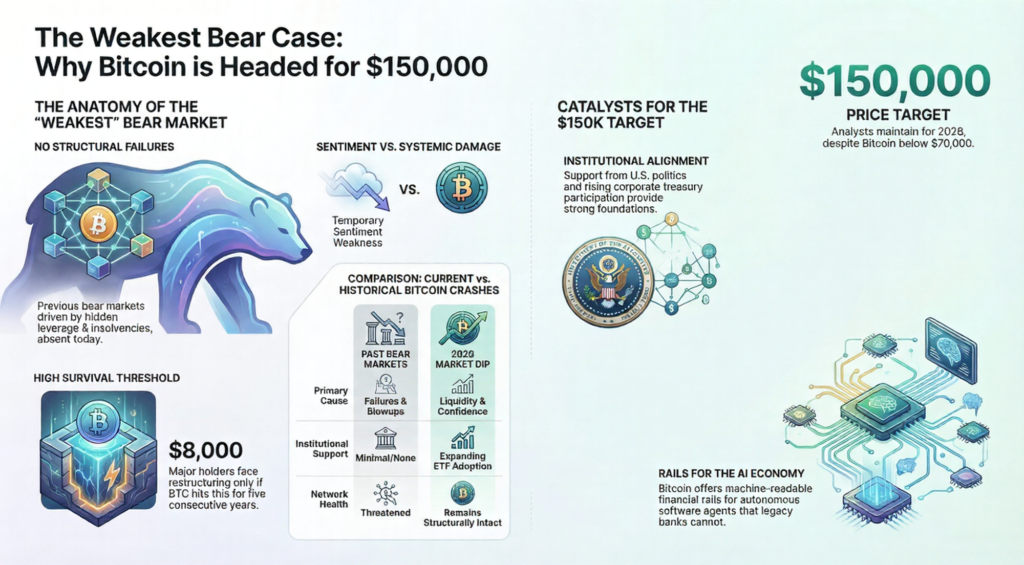
Despite recent market volatility that has seen Bitcoin (BTC) trading slightly below the $70,000 mark, research and brokerage firm Bernstein has issued a fiercely bullish update. In a report released on February 9, 2026, analysts characterized the current market downturn as the “weakest bear case” in the asset’s history and reaffirmed their ambitious price target of $150,000 by the end of the year.

For investors concerned about the recent drawdown, Bernstein’s message is clear: this is a crisis of confidence, not a structural failure.

A “Weak” Bear Market: No Systemic Failures

Bernstein’s latest analysis distinguishes the current market environment from the brutal “crypto winters” of the past. According to the firm, previous bear markets were precipitated by tangible catastrophes—major corporate failures, the unraveling of hidden leverage, or systemic breakdowns within the crypto ecosystem.

In stark contrast, the analysts note that the current cycle lacks these negative catalysts. “What we are experiencing is the weakest bitcoin bear case in its history,” the analysts wrote. They argue that there have been no comparable blowups or widespread insolvencies to justify a prolonged bearish outlook. instead, the market is suffering from sentiment weakness rather than any fundamental flaw in the Bitcoin network or its investment thesis.

Institutional Alignment and the “Pro-Bitcoin” Environment

A key pillar of Bernstein’s bullish thesis is the unprecedented level of institutional alignment supporting the asset class. Unlike previous cycles where Bitcoin faced regulatory headwinds or institutional skepticism, the current landscape is defined by deep integration with traditional finance.

The analysts highlighted several factors bolstering this view:

A favorable political climate: The report cites a “pro-bitcoin U.S. political environment” as a stabilizing force.

ETF Adoption: The continued expansion and adoption of spot BTC ETFs provide a regulated on-ramp for capital.

Corporate Participation: There is rising participation from corporate treasuries and continued involvement from large asset managers.

Bernstein argues that the broader story of Bitcoin adoption remains completely intact, despite the temporary price action.

Bitcoin vs. Gold: Understanding the Liquidity Dynamic

Critics have recently pointed out that Bitcoin has lagged behind gold during this period of macroeconomic volatility. Bernstein addressed this divergence directly, clarifying that Bitcoin currently behaves primarily as a “liquidity-sensitive risk asset” rather than a mature safe haven like gold.

The report notes that elevated interest rates and tighter financial conditions have funneled gains into specific sectors, such as precious metals and AI-linked equities. However, Bernstein remains confident that the infrastructure is in place—specifically through BTC ETFs and corporate capital-raising channels—to absorb renewed liquidity as soon as macroeconomic conditions ease.

The AI Economy: Bitcoin’s Role in an “Agentic” Future

Beyond price targets, Bernstein pushed back against the narrative that Bitcoin is losing relevance in an economy increasingly dominated by Artificial Intelligence (AI).

Far from being obsolete, Bernstein posits that blockchains and programmable wallets are essential for an emerging “agentic” digital environment. As autonomous software agents become more prevalent, they will require global, machine-readable financial rails to operate. The analysts argue that traditional banking systems, with their closed APIs and legacy barriers, are ill-equipped to serve this need, leaving Bitcoin to play a central role.

Dismissing the “FUD”: Quantum Computing and Miner Capitulation

The report also tackled persistent fears regarding quantum computing and corporate leverage, labeling much of the concern as “FUD” (Fear, Uncertainty, and Doubt).

1. The Quantum Threat Bernstein acknowledged that while future cryptographic threats are real, Bitcoin is not uniquely exposed. “All critical digital systems face similar risks and will transition toward quantum-resistant standards together,” the firm argued.

This sentiment was echoed by Michael Saylor, Executive Chairman of Strategy (MicroStrategy), during the company’s fourth-quarter 2025 earnings call. Saylor announced a “Bitcoin Security Program” to coordinate defense with the broader cyber community, framing quantum computing as a future engineering challenge rather than an immediate existential threat. He emphasized that any necessary upgrades to the Bitcoin protocol would be achieved through global consensus, a process consistent with Bitcoin’s history of adapting to technical pressure.

2. Corporate Leverage and Miner Health Bernstein also dismissed concerns that leveraged corporate holders or miners might capitulate, driving prices lower. The analysts observed that major Bitcoin-holding firms have structured their liabilities to withstand significant volatility.

Citing data from Strategy (MicroStrategy), the analysts noted that the company’s balance sheet would only require restructuring in an extreme scenario—specifically, if Bitcoin were to fall to $8,000 and remain there for five years. With Bitcoin trading near $70,000, the market is far removed from such distress levels.

The Road to $150,000

Ultimately, Bernstein sees the current selloff as a temporary sentiment dip in a structurally sound market. With no hidden leverage bubbles bursting and a clear path for institutional adoption, the firm remains steadfast in its prediction.

The analysts concluded by reiterating their forecast: Bitcoin is on track to reach $150,000 by the end of 2026.

——————————————————————————–

Disclaimer: This article is based on analyst reports and historical data as of February 2026. It does not constitute financial advice. Digital assets are highly volatile; investors should conduct their own due diligence.