
How AI Agents Are Changing Crypto Research
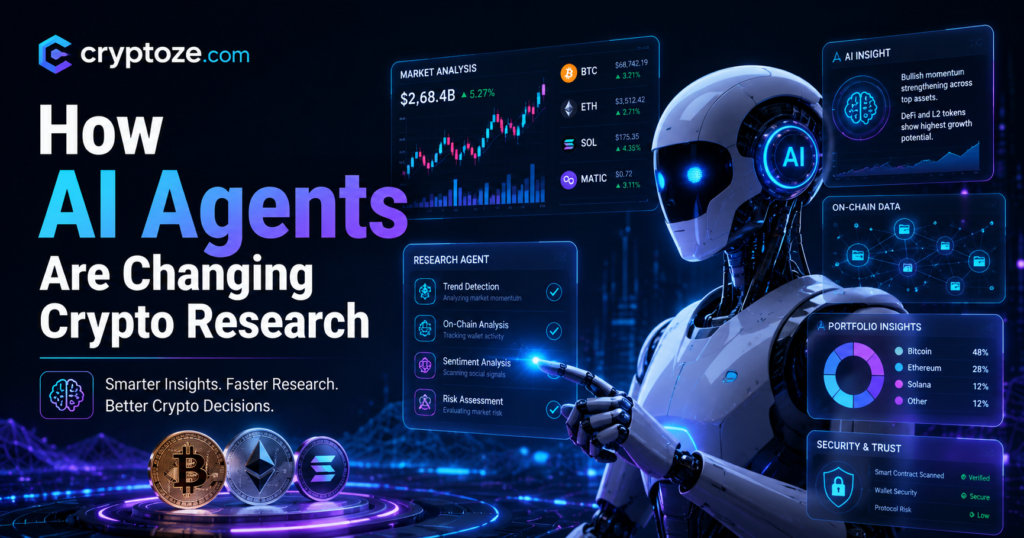
AI agents are reshaping crypto research by automating data collection, on-chain analysis, and market monitoring at a scale no human analyst can match. For crypto investors and researchers in 2026, understanding how these tools work—and where they fall short—is increasingly essential.
The crypto market generates enormous volumes of data every second: price movements, on-chain transactions, social sentiment, protocol updates, and regulatory developments. Traditionally, keeping pace with all of this required teams of analysts working around the clock. AI agents are changing that equation.
What Are AI Agents in the Context of Crypto Research?
An AI agent is an autonomous software system that perceives its environment, processes information, and takes goal-directed actions—often without human intervention. In the context of crypto research, AI agents can be deployed to monitor blockchain data, scan news sources, analyze token fundamentals, and flag anomalies in real time.
Unlike static AI tools that respond to single prompts, AI agents operate continuously, chain multiple reasoning steps together, and adapt their behavior based on new information.
How Are AI Agents Being Used in Crypto Research?
AI agents are being applied across several core areas of crypto research:
- On-chain data analysis: AI agents parse transaction histories, wallet behavior, liquidity flows, and smart contract activity to surface insights that would take human analysts hours to compile.
- Sentiment analysis: By scanning social platforms, forums, and news in real time, AI agents can gauge market sentiment around specific tokens or protocols.
- Due diligence automation: AI agents can review whitepapers, audit reports, and tokenomics structures, flagging inconsistencies or red flags for human review.
- Market monitoring and alerts: Agents can track price movements, unusual trading volumes, and whale wallet activity, issuing alerts when predefined thresholds are crossed.
- Competitive intelligence: AI agents monitor competitor protocols, governance proposals, and ecosystem developments to inform investment or research strategy.
Why AI Agents Are Particularly Well-Suited to Crypto
The crypto market operates 24/7 across hundreds of chains and thousands of tokens. This creates a data environment that is uniquely suited to AI-driven research tools. Key reasons AI agents are gaining traction in this space include:
- Speed: AI agents process and act on data in milliseconds, far faster than any human researcher.
- Scale: A single AI agent can simultaneously monitor thousands of assets, wallets, or data feeds.
- Availability: Unlike human analysts, AI agents operate continuously without fatigue or downtime.
- Consistency: AI agents apply the same analytical criteria every time, reducing the variability introduced by human judgment under pressure.
What Are the Limitations of AI Agents in Crypto Research?
AI agents are powerful, but they are not infallible. Key limitations include:
- Hallucination risk: AI systems can generate plausible-sounding but inaccurate outputs, particularly when reasoning about novel protocols or low-liquidity assets with sparse training data.
- Data quality dependency: An AI agent is only as reliable as the data it ingests. Poor or manipulated data sources can lead to flawed conclusions.
- Lack of contextual judgment: AI agents may struggle to interpret novel market events, regulatory shifts, or macroeconomic developments that fall outside their training distribution.
- Over-reliance risk: Researchers who defer entirely to AI-generated outputs without human oversight may miss nuances that experienced analysts would catch.
AI agents are better suited to teams that need to process high volumes of structured, on-chain data at speed, while human analysts remain better positioned to assess qualitative factors, emerging narratives, and contextual judgment calls.
How AI Agents Compare to Traditional Crypto Research Methods
Traditional crypto research relies on manual data aggregation, analyst expertise, and structured reports produced on periodic schedules. AI agent-driven research, by contrast, is continuous, scalable, and increasingly real-time.
Traditional research is better suited for nuanced, narrative-driven analysis—for example, evaluating a founding team’s track record or interpreting a regulatory announcement. AI agents are better suited for pattern recognition across large datasets, anomaly detection, and high-frequency monitoring tasks.
The most effective research workflows in 2026 tend to combine both: AI agents handle the data-intensive layer, while human analysts focus on interpretation, judgment, and communication.
Frequently Asked Questions
Q: Can AI agents replace human crypto analysts?
A: Not fully. AI agents can automate data-intensive tasks like on-chain monitoring, sentiment tracking, and pattern detection, but human analysts remain essential for contextual judgment, qualitative assessment, and navigating novel market events that fall outside an AI’s training data.
Q: Are AI agents used by institutional crypto investors?
A: Yes. Institutional investors and crypto-native funds are increasingly deploying AI agents for tasks like portfolio monitoring, risk flagging, and due diligence support—particularly given the 24/7 nature of crypto markets and the volume of data involved.
Q: How do AI agents access blockchain data?
A: AI agents typically connect to blockchain data via APIs provided by on-chain data platforms, node providers, or blockchain indexers. They can query transaction histories, smart contract states, wallet balances, and protocol metrics in near real-time.
Extra Notes: Get Job-Ready With Your Personal AI Career Coach – FluentCareer AI
Make Your Website Ready for AI Agents – AgentDocs AI
Free AI Tools –AI tools directory AI Tools for Work, Business, Creativity & Automation
Unlock Powerful AI Prompts for Content, Business, SEO & Creativity – PromptFusion AI
Related guides
Best AI Tools for Finding Airdrops 2026
Quick answer: The best AI-powered tools for finding crypto airdrops include CryptoRank Drop Hunting, Earnifi, Lootbot, Earndrop, and…

AI Crypto Trading Bots 2026: Beginner Guide and Risks
AI crypto trading bots are automated software programs that use artificial intelligence to execute cryptocurrency trades on behalf…

Best AI Crypto Tools for Beginners 2026
Best AI Crypto Tools for Beginners is an important topic for beginners who want to understand crypto airdrops,…