The Identity Crisis: Why Bitcoin Trades Like Tech, Not Gold
Introduction: The Tech Trade Reality
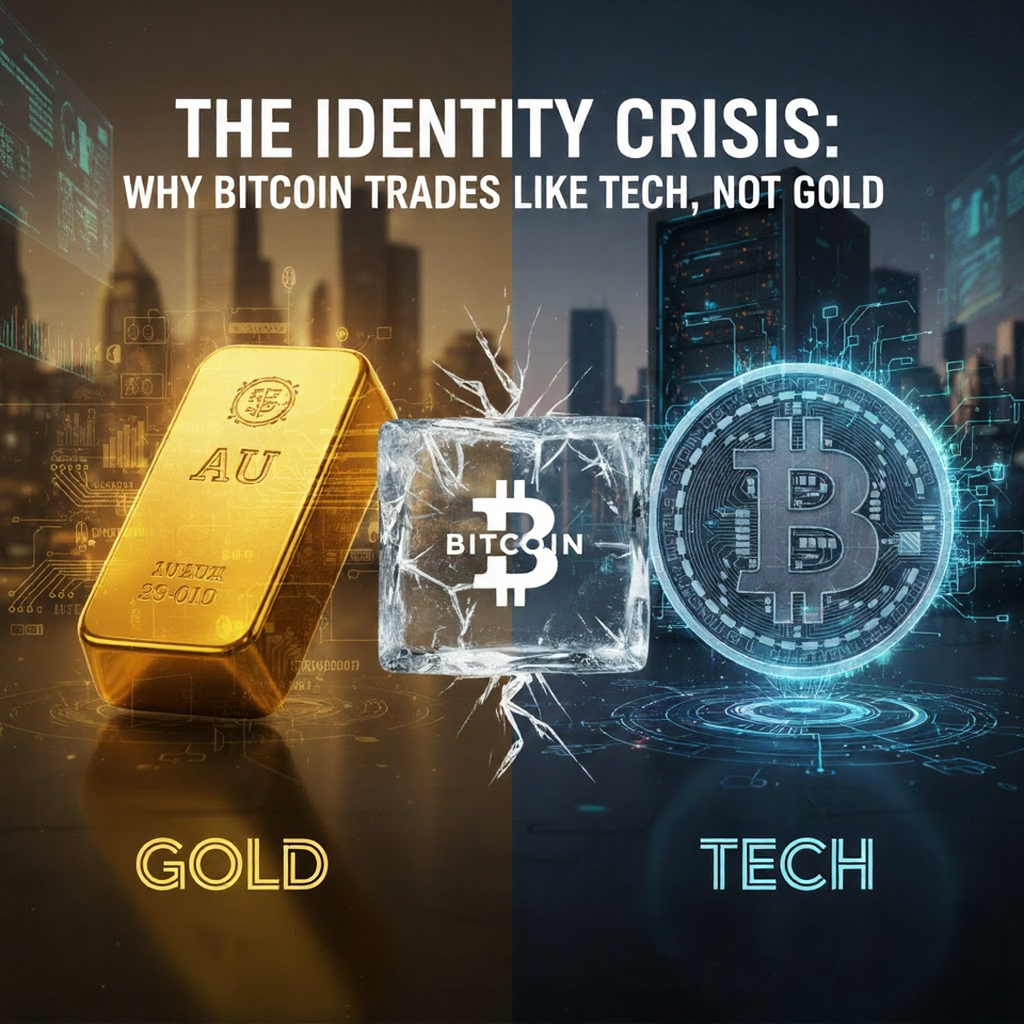
For years, proponents of cryptocurrency have championed the narrative of “digital gold”—the idea that Bitcoin serves as a non-sovereign, scarce store of value that can hedge against traditional market volatility. However, recent market data suggests that this narrative is, for the moment, premature. According to a recent report by crypto asset manager Grayscale, Bitcoin is currently behaving less like a mature safe haven and more like a speculative technology play.
During the sell-off earlier this month, which saw Bitcoin slide to approximately $60,000, the asset did not behave in the way gold investors would recognize. Instead, the decline looked familiar to tech investors. As high-growth software stocks retreated, Bitcoin fell in “near lockstep,” reinforcing the perspective that the world’s largest cryptocurrency currently trades as an emerging technology rather than a stabilized store of value.
The Maturity Gap: 17 Years vs. Millennia
The core of the issue lies in the timeline of adoption and trust. Grayscale’s analysis highlights a fundamental distinction between the potential of Bitcoin and its current state. Bitcoin possesses the necessary design features to function as a long-term store of value: it has a capped supply, it operates independently of governments, and it runs on a resilient, decentralized network. These qualities theoretically position it to preserve purchasing power over time.
However, the asset is only 17 years old. When placed against the backdrop of gold’s history, which spans millennia, Bitcoin is still in the earliest stages of its monetary journey. As Zach Pandl, Grayscale’s head of research, noted, while the network is likely to operate well beyond our lifetimes and retain value in real terms, it has not yet achieved the historical gravitas required to act as a definitive shield against immediate market stress.
The Divergence: Safe Haven or Risk Asset?
The “digital gold” thesis has faced significant scrutiny in recent months due to a distinct divergence in asset performance. Theoretically, a safe haven asset should hold its value or appreciate during periods of market stress. Yet, recently, Bitcoin has done the opposite. Rather than offering protection, it has fallen sharply from its highs, moving in tandem with risk assets as investors shifted to defensive positions.
The contrast with physical gold is stark. At the exact moment Bitcoin was experiencing capital exits, physical gold surged to record levels, drawing significant inflows. This split has substantially weakened the argument that Bitcoin reliably holds value during moments of acute market stress. It suggests that mathematical scarcity alone is currently insufficient to force Bitcoin to behave like gold when investors prioritize protection over growth.
The Bet on Adoption
If Bitcoin is not yet digital gold, what is it? According to Pandl, investing in Bitcoin today is fundamentally a “bet on adoption”. Until the asset achieves widespread acceptance as a global monetary standard, its price action will remain tethered to global risk appetite.
This means that Bitcoin’s valuation rises and falls along with growth-oriented portfolios. When investors are bullish on the future of technology and expansion, Bitcoin thrives. When they retreat from risk, Bitcoin suffers. This dynamic explains why the asset acts as a high-beta tech stock rather than a counter-cyclical hedge.
Recent market mechanics validate this view. The selling pressure has been largely U.S.-led, characterized by a sharp deleveraging across crypto derivatives and outflows from spot Bitcoin exchange-traded funds (ETFs). These signals are indicative of a “growth unwind”—investors reducing exposure to risky bets—rather than a crisis of confidence in the Bitcoin network itself.
Institutional Sentiment and ETF Flows
The cooling of institutional appetite is evident in the recent performance of spot Bitcoin ETFs. After an initial period of enthusiasm, U.S.-listed funds have logged a sustained run of outflows, shedding hundreds of millions of dollars. These withdrawals, driven by falling prices and market volatility, have dragged down the total assets under management for these products.
This trend underscores a softening in demand for ETF-based exposure. Many positions are now underwater, leading investors to pull back. However, while the ETF market experiences friction, the broader crypto ecosystem continues to see inflows elsewhere, suggesting that the hesitation is specific to the current price volatility rather than a complete abandonment of the asset class.
The Path Forward: Infrastructure and Innovation
Despite the current correlation with tech stocks, Grayscale sees the foundations for a recovery and eventual maturation. This outlook extends beyond short-term price action to the structural growth of the blockchain sector. Momentum is building around regulatory clarity for stablecoins and tokenized assets, alongside continued innovation in blockchain infrastructure.
The report highlights that platforms such as Ethereum and Solana, as well as middleware providers like Chainlink, stand to benefit from this next phase of adoption. As these technologies mature, they may provide the utility and stability required to transition the asset class from a speculative growth trade to a fundamental component of the financial system.
The Long-Term Horizon
Bitcoin’s ultimate test is still unfolding. For the asset to eventually mimic the behavior of gold, it must clear several significant technical and systemic hurdles. Questions regarding network scaling, transaction fees, and future resistance to quantum computing remain unresolved.
However, the Grayscale report argues that if Bitcoin can successfully navigate these challenges, its profile will evolve. Over time, its volatility is expected to fall, and its correlation with equities should fade. In this scenario, its behavior may eventually resemble that of gold, but with a “digital backbone”. Wall Street giants like JPMorgan have echoed this sentiment, noting that lower volatility relative to gold could eventually make Bitcoin “more attractive” in the long term.
Conclusion
For the time being, investors must recognize the duality of Bitcoin. While its code promises the stability of a digital commodity, its market reality is that of an emerging technology stock. It is a growth trade fueled by a bet on future adoption, prone to the same volatility as the software sector. While the path toward becoming “digital gold” is visible, the market data confirms that Bitcoin has not yet arrived at that destination.